
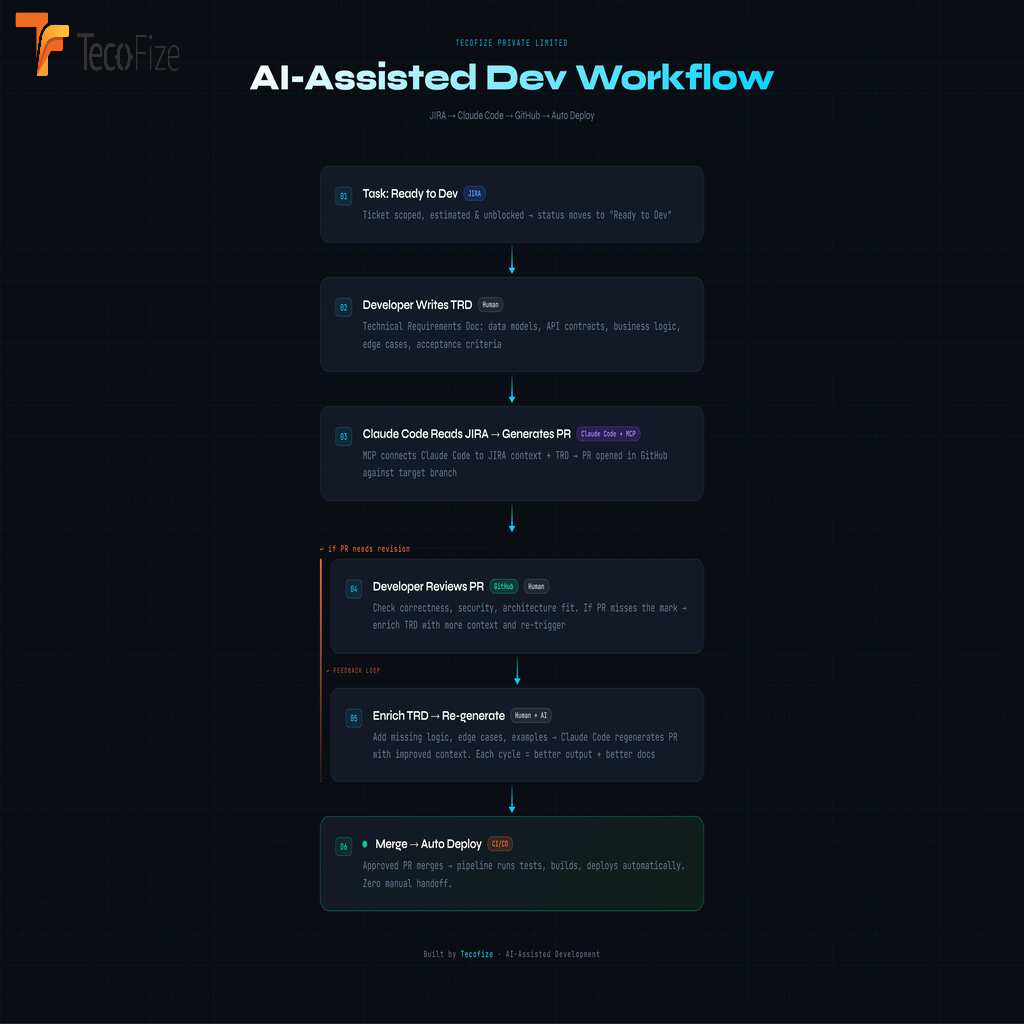
How we connected JIRA, Claude Code, and GitHub to ship faster - without losing engineering quality
At Tecofize, we work with clients across industries to build and scale software products. Over the past year, we've been refining an AI-assisted development workflow that has meaningfully changed how our team moves from requirements to deployed code. This isn't a "replace your developers" story. It's a story about removing friction - and where the real engineering work actually lives
The Problem With Most AI Dev SetupsMost teams that try to use AI for development hit the same wall: the AI produces generic, surface-level code that doesn't reflect the actual requirements. Developers end up rewriting more than they saved. Frustration sets in, and the experiment gets shelved.
The root cause is almost always the same - bad input produces bad output. AI doesn't understand your system architecture, business logic, or edge cases unless you tell it. And most teams haven't built a structured way to do that.
We solved this with TRDs and a feedback loop
The Workflow: Step by Step 1. JIRA → Ready to DevEverything starts in JIRA. When a task is scoped, estimated, and unblocked, it moves to "Ready to Dev" status. This is the trigger for the workflow to begin.
The task should already contain the business context: what the feature is, why it's needed, acceptance criteria, and any design references.
2. Developer Writes a TRD (Technical Requirements Document)This is the most important step in the entire workflow.
Before any AI touches the code, the assigned developer writes a Technical Requirements Document directly linked to the JIRA ticket. A good TRD covers:
● Data models - What entities are involved? What are the fields, types, and relationships? ● API contracts - Endpoints, request/response shapes, authentication requirements ● Business logic - Decision trees, conditional flows, validation rules ● Edge cases — What should happen when inputs are invalid, services are down, or data is missing? ● Acceptance criteria — What does "done" look like? How will this be tested?
Think of the TRD as the specification you'd give a senior developer on their first day. If they could build it correctly from your TRD alone, it's detailed enough for the AI.
3. Claude Code Reads JIRA via MCP and Generates a PRWith the TRD in place, Claude Code enters the workflow. Using the Model Context Protocol (MCP), Claude Code connects directly to JIRA and reads the full task context — the ticket description, linked documents, acceptance criteria, and the TRD.
It then generates code against your codebase and opens a pull request in GitHub.
This isn't copy-paste boilerplate. Because Claude Code has access to your existing codebase structure, it generates code that fits your patterns, follows your conventions, and addresses the specific requirements in your TRD
4. Developer Reviews the PRThe developer reviews the pull request the same way they'd review any human-written code — checking for correctness, security, architecture fit, and edge case handling.
Two things can happen here:
If the PR is good → merge and deploy (more on that below). If the PR misses the mark → the feedback loop begins. 5. The Feedback Loop: Enriching the TRDThis is where most AI workflows stop — and where ours gets interesting.
When a PR doesn't meet the bar, the developer doesn't just reject it and move on. They ask: why did the AI miss this? Almost always, the answer is that the TRD lacked specificity in one area.
The developer goes back to the TRD and adds more context:
● More detailed logic descriptions ● Explicit examples of expected behavior ● Clarification on edge cases that weren't covered ● Additional constraints or system dependencies
Then they run the generation cycle again.
Each iteration produces a better PR. And as a side effect, each iteration produces better documentation — documentation that lives permanently in your JIRA ticket and serves future developers and future AI runs alike.
The feedback loop isn't a failure state. It's a quality ratchet.
6. Merge → Automatic DeploymentOnce the PR passes review and is approved, the developer merges it. From there, your existing CI/CD pipeline handles the rest — running tests, building, and deploying to the target environment automatically.
No manual deployment steps. No handoff delays.
Why This Works: The TRD Is the New Leverage PointIn traditional development, engineering judgment lives in the code. In this workflow, engineering judgment moves upstream — into the TRD
This is a shift worth internalizing. The developer's highest-value contribution is no longer writing the implementation. It's writing a spec precise enough that the implementation almost writes itself.
This means:
● Senior developers spend their time on architecture and specification, not boilerplate ● Junior developers learn to think more rigorously about requirements before touching code ● The codebase accumulates detailed documentation as a natural byproduct of development
What You Need to Implement This| Component | Tool |
|---|---|
| Task Management | JIRA |
| AI Coding Agent | Claude Code |
| JIRA Integration | MCP (Model Context Protocol) |
| Code Repository | GitHub |
| CI/CD | GitHub Actions (or your existing pipeline) |
The MCP connection between Claude Code and JIRA is what makes this feel seamless. Claude Code can read ticket descriptions, linked documents, and custom fields — so nothing gets lost in translation between your task management system and your codebase.
What This Workflow Is Not
To be clear: this is AI-assisted development , not autonomous development.
Developers are still essential. They write the TRDs, review the PRs, make architecture decisions, and own the quality of what ships. The AI is a fast, capable implementer — but it needs precise direction
Teams that treat AI as a replacement for engineering judgment will be disappointed. Teams that treat it as a high-speed implementation engine with clear specifications will see real results.
Results We've SeenSince implementing this workflow, we've observed:
● Faster cycle times from ticket to PR — particularly on well-defined, scoped tasks ● Improved documentation quality across projects as a natural byproduct of TRD writing ● Fewer review cycles on complex features where TRDs were written with sufficient detail ● Developers spending more time on high-leverage work: architecture, review, and specification
Want to Implement This in Your Team?At Tecofize, we help engineering teams design and implement AI-assisted development workflows tailored to their stack and processes.
If you're exploring how to integrate tools like Claude Code, MCP, and your existing JIRA and GitHub setup — we'd be happy to walk you through our approach.
Get in touch with Tecofize → https://tecofize.com/contact